




If a child is in immediate danger, call 000.
Nhulundu Health Service is committed to the safety, wellbeing and empowerment of all children and young people. This page explains how we keep children safe and how you can raise a concern.
Download our Statement of Commitment (PDF)
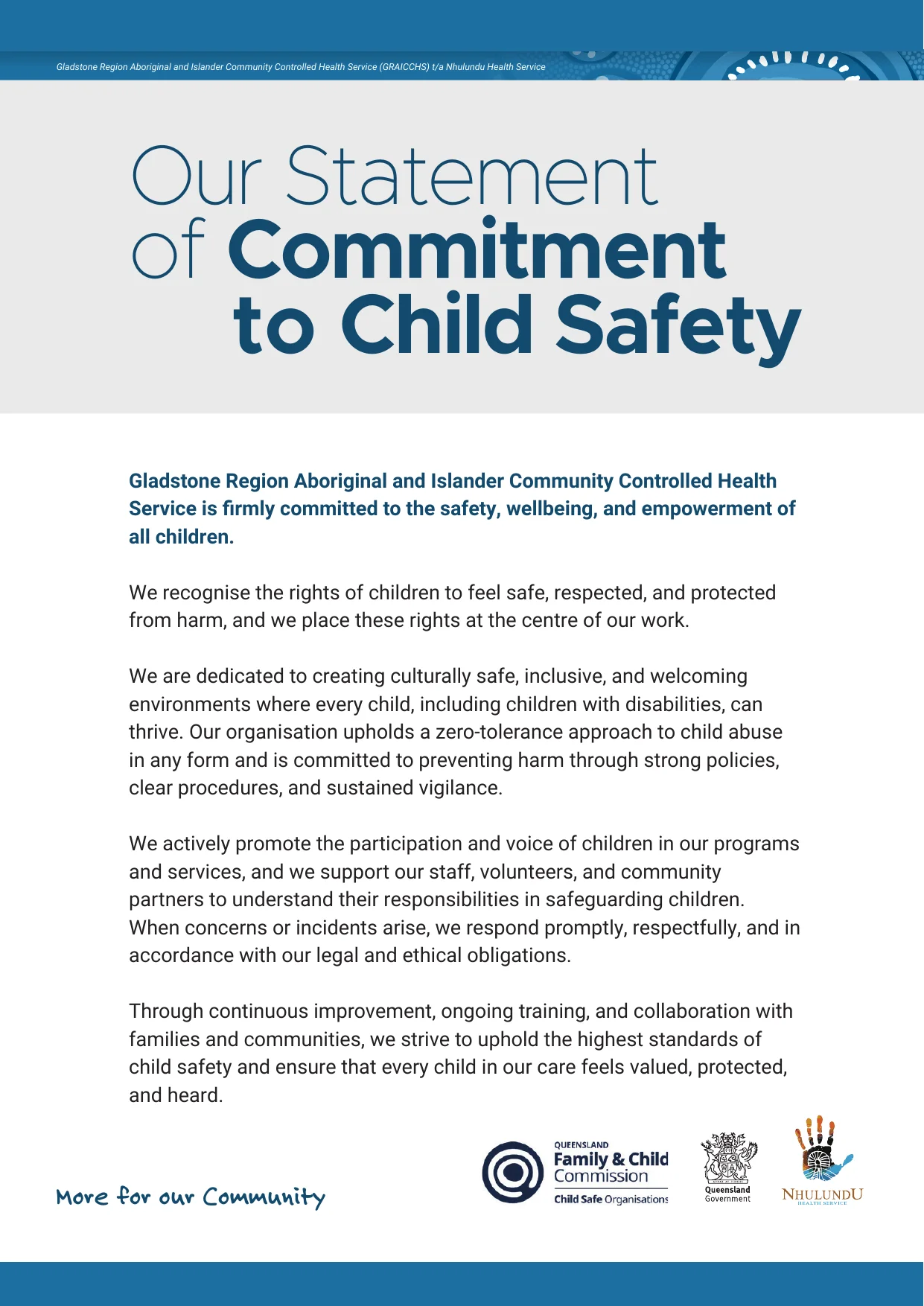
Our Commitment to Child Safety
Gladstone Region Aboriginal and Islander Community Controlled Health Service is firmly committed to the safety, wellbeing, and empowerment of all children.
We recognise the rights of children to feel safe, respected, and protected from harm, and we place these rights at the centre of our work.
We are dedicated to creating culturally safe, inclusive, and welcoming environments where every child, including children with disabilities, can thrive. Our organisation upholds a zero-tolerance approach to child abuse in any form and is committed to preventing harm through strong policies, clear procedures, and sustained vigilance.
We actively promote the participation and voice of children in our programs and services, and we support our staff, volunteers, and community partners to understand their responsibilities in safeguarding children. When concerns or incidents arise, we respond promptly, respectfully, and in accordance with our legal and ethical obligations.
Through continuous improvement, ongoing training, and collaboration with families and communities, we strive to uphold the highest standards of child safety and ensure every child in our care feels valued, protected, and heard.
Queensland’s Child Safe Standards
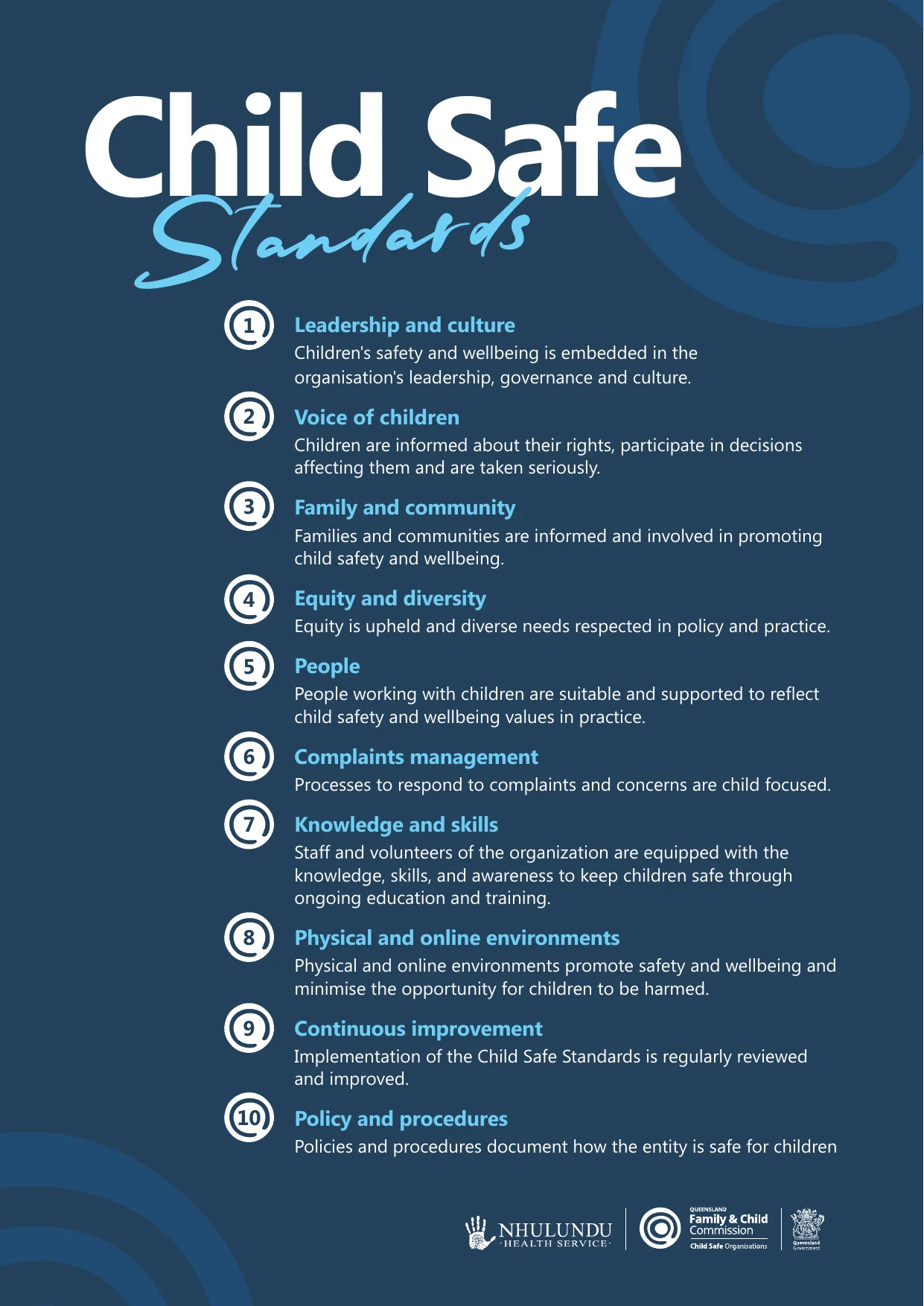
Queensland law (Child Safe Organisations Act 2024) requires organisations that work with children to meet ten Child Safe Standards and to protect the cultural safety of Aboriginal and Torres Strait Islander children.
- Leadership and culture: children’s safety and wellbeing is embedded in our leadership, governance and culture.
- Voice of children: children are informed about their rights, participate in decisions affecting them and are taken seriously.
- Family and community: families and communities are informed and involved in promoting child safety and wellbeing.
- Equity and diversity: equity is upheld and diverse needs are respected in policy and practice.
- People: people working with children are suitable and supported to reflect child safety and wellbeing values in practice.
- Complaints management: our processes to respond to complaints and concerns are child focused.
- Knowledge and skills: staff and volunteers have the knowledge, skills and awareness to keep children safe through ongoing education and training.
- Physical and online environments: our physical and online environments promote safety and wellbeing and minimise the opportunity for children to be harmed.
- Continuous improvement: we regularly review and improve how we apply the Standards.
- Policy and procedures: our policies and procedures document how we keep children safe.
Cultural safety
As an Aboriginal community controlled organisation, we are committed to environments where Aboriginal and Torres Strait Islander children are culturally safe, connected to family, culture and community, and respected.
How we keep children safe
Our people
- Everyone who works with children must hold a valid Queensland Working with Children Check (Blue Card) and a National Criminal History Check.
- Staff in our Children, Youth and Families programs, our management and our Board also complete Child Safety and Personal History Screening (LCS2), as required for our foster and kinship care licence.
- Our job advertisements and position descriptions state our commitment to child safety, and interviews test applicants’ understanding of safeguarding.
Training and support
- Staff, volunteers and contractors complete regular child safety training, including reporting obligations and building culturally safe environments.
- Child safety is a standing item on meeting agendas and part of supervision and performance reviews.
- Our Children, Youth and Families Manager is our child safety officer and supports staff to understand their responsibilities.
Our Code of Conduct
- Our staff must keep children safe and listen to their views and concerns. They must make sure another adult is present or in sight during one-to-one activities, respond to complaints quickly, fairly and openly, and report any concern about a child.
- They must not develop special relationships with children, such as favouritism or gifts, be inappropriately alone with a child, or discriminate against any child.
- Breaches are taken seriously and can lead to disciplinary action, including termination of employment.
Safe spaces, online and in person
- Areas where children are present are supervised, and we risk-assess our premises, equipment and activities.
- We always get written permission from a child and their parent or guardian before taking or sharing a photo, and we protect children’s identities in published material.
Reportable Conduct Scheme
- We are committed to complying with Queensland’s Reportable Conduct Scheme, which requires organisations to respond to allegations of child abuse and misconduct by workers, volunteers, contractors and others they engage.
Reviewing what we do
- Our Child Safety Policy was endorsed by the Board on 3 September 2026 and is reviewed regularly, next due September 2028. We use feedback from children, families and staff to improve.
If you have a concern
You do not need to be certain, and you do not need proof. If something worries you about a child’s safety or wellbeing, tell someone.
In an emergency
- Call 000 if a child is in immediate danger.
Raising a concern with Nhulundu
- Online: use our feedback form and choose Concern about a child’s safety or wellbeing. You can leave your name off.
- Phone: 1800 293 293 or (07) 4979 0992
- Email: cyf@nhulundu.com.au
- In person: at our clinic, 27–29 Goondoon Street, Gladstone, or tell any staff member.
- Concerns about a child, or about how an adult is behaving around a child, go to our Children, Youth and Families Manager or senior management.
What happens next
- Concerns about a child are passed to our Children, Youth and Families Manager or a member of our senior management team, and we act on them the same day.
- Where a child may be at risk of significant harm, we report to The Department of Child Safety. Sexual offences against children are reported to the police.
- Anyone accused of wrongdoing is treated fairly, and the safety of the child comes first.
- People who raise a concern in good faith will not be punished for doing so.
- We will let you know we have received your concern and what happens next. For complaints and feedback, we aim to give you an outcome within 7 business days.
Reporting directly to the authorities
You can always go straight to:
- Child Safety, Regional Intake Service (Sunshine Coast and Central Queensland): 1300 703 762 (business hours). After hours, Child Safety After Hours Service Centre: 1800 177 135 (24 hours, 7 days).
- Queensland Police: PoliceLink 131 444, or Gladstone Police Station (07) 4971 3222.
- Queensland Family and Child Commission (QFCC): (07) 3900 6000 or enquiries@qfcc.qld.gov.au. You can contact the QFCC about concerns that an organisation is not meeting the Child Safe Standards, or about reportable conduct by an organisation’s workers.
- Department of Families, Seniors, Disability Services and Child Safety: compliments and complaints, 1800 080 464 or online.
If you are a young person
You have the right to feel safe. You can say no. We will listen to you.
- If something is worrying you, or someone is hurting you or making you feel unsafe, tell an adult you trust.
- You can talk to any of our staff, or ask for the Children, Youth and Families Manager.
- You can call us on 1800 293 293, or use the feedback form and choose Concern. You don’t have to give your name.
- If you are in danger right now, call 000.
- Kids Helpline is free, private and open 24 hours, for young people aged 5 to 25: 1800 55 1800.
Staff can’t promise to keep a safety concern secret, because we need to get you help. We will tell you who we are sharing it with and why.
Our policies and resources
- Statement of Commitment to Child Safety
- Child Safe Standards poster
- Child Safety Policy
- Compliments, Concerns, Complaints and Suggestions Form (for anonymous feedback)
Making a complaint or giving feedback
Compliments, complaints and suggestions are welcome from children, young people and families, in person, by phone, by email or through our online form. We will keep a record and let you know we have received your complaint or feedback. We aim to give you an outcome within 7 business days. If you are not happy with the outcome, you can take your complaint to the Department of Families, Seniors, Disability Services and Child Safety or the Queensland Family and Child Commission.
 Feedback Form